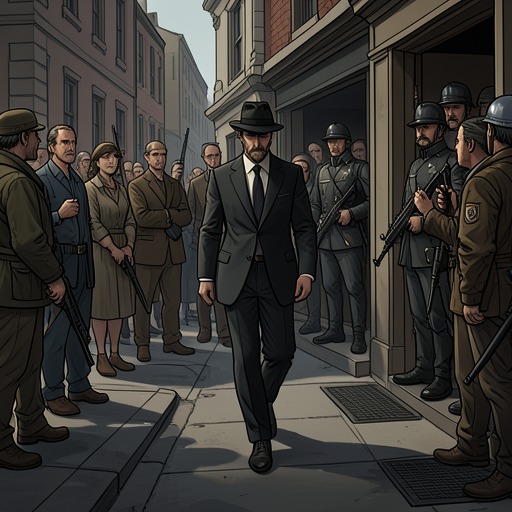
Flaco
The Power of the DogFlaco is one of two homeless young men whom Fabián Martínez recruits to bear responsibility for the killing of Cardinal Juan Ocampo Parada, despite acknowledging that they did not do the shooting. His brief arc turns on the difference between the loyalty Fabián asks them to perform and the vulnerability that makes the request possible. Arrested after crossing the border, Flaco later dies in custody; the official explanation of his death does not account for evidence of violence.
Identity and Recruitment
Flaco is living with Dreamer beneath the Laurel Street Bridge in Balboa Park when Fabián finds them. The setting establishes their precarious position before the recruitment begins: they are sleeping under a bridge, exposed to the threat of police intervention and with little apparent power to refuse someone acting on behalf of Adán Barrera.
One night, Fabián wakes the pair. Flaco initially fears that the person approaching them may be a police officer; when he recognizes Fabián, his fear changes rather than disappearing. He looks up at the visitor apprehensively, uncertain whether Fabián has come to kill him. Fabián instead presents the encounter as a demand that the two young men prove their courage. The appeal to brotherhood and bravery makes the proposal sound like a test of character, though the circumstances offer Flaco little security or leverage.
Fabián’s offer supplies the practical terms behind that appeal. He tells the young men that they did not commit the shooting and argues that, because they are young, they will receive only short prison sentences. He promises that their families will be cared for while they are imprisoned and that Adán Barrera will remember their service afterward. He singles out Flaco’s mother, who works as a motel maid, making the family’s economic vulnerability part of the bargain. The promised future favor is set against a near-term sacrifice that Flaco and Dreamer are expected to make for others.
Crossing and Arrest
As the two young men approach the border, Flaco becomes visibly afraid. His legs shake, his knees knock together, and he cries; he is ashamed of his fear even as he hears Dreamer crying as well. Their parallel reactions complicate the language of courage that Fabián has used to recruit them. The scene does not present fear as proof that Flaco has accepted the bargain freely; it shows two vulnerable young men approaching danger while acutely aware of it.
They pass through Immigration and Customs without difficulty and begin walking south into the city. About two blocks later, searchlights catch them. Police officers order them to raise their hands, and Flaco obeys. An officer takes him to the ground and handcuffs him. The abrupt arrest marks the end of the crossing and the beginning of the state’s custody, but it does not establish what the authorities will do with the account Fabián has prepared or the responsibility the young men have been asked to assume.
Custody and Death
Later, Flaco is blindfolded. Although one eardrum has been ruptured, he can hear Dreamer pleading nearby. The available account places Flaco in a setting of intimidation and violence, rather than depicting the promised short prison term as an uncomplicated or reliable outcome. When a gun is pointed at him and fired without a bullet, he collapses in fear. The threat does not provide evidence that Flaco has confessed or that the men responsible have established what happened to Cardinal Juan Ocampo Parada; it does show how thoroughly the young men have been placed at the mercy of their captors.
Their stories appear in the papers the following morning. The coroner later rules that Flaco and Dreamer died by double suicide, attributing their deaths to guilt over killing Cardinal Juan Ocampo Parada. That conclusion is presented as the official explanation, not as a settled account supported by every detail. The coroner does not address the unexplained blunt-force injuries to the backs of their heads. Flaco’s final image is also distinct from the account of guilt: his tongue hangs from his mouth, a physical detail that the official verdict leaves unexplained rather than resolving.
Narrative Significance
Flaco’s story exposes the distance between a powerful figure’s assurances and the outcomes faced by the people recruited to protect that power. Fabián explicitly acknowledges that Flaco and Dreamer did not carry out the shooting, yet offers family support and future standing with Adán Barrera in exchange for their willingness to take the consequences. The promise is specific enough to make the bargain persuasive, especially when Fabián brings Flaco’s mother and her work into it; it cannot make the danger disappear.
The account of Flaco’s death is divided between public explanation and unresolved physical evidence. The newspaper coverage and coroner’s verdict turn the young men’s deaths into a story of guilt, while the neglected injuries leave that story incomplete. Flaco therefore remains more than a recruited substitute: his brief presence shows how the language of bravery and loyalty can be used to draw the powerless into a crisis, and how an official explanation can close a case without accounting for all that the narrative has disclosed.